
Backyard flooding happens when rain can't drain away. Illinois guidance names the places to look: downspouts dumping roof water by the house, ground that slopes toward the foundation, low spots, and soil too saturated or poorly drained to absorb more. The main backyard flooding solutions for yards across Chicago's northwest suburbs, including Mount Prospect, are regrading, French drains, dry wells, downspout pop-ups and rain gardens.
Wave Outdoors installs each of these from its base in Mount Prospect. But the right fix depends on where the water comes from, so find the source first. The Illinois Department of Natural Resources says identifying the source of flooding is fundamental before choosing a remedy.
Find the water source before choosing a fix
The Illinois Department of Natural Resources (IDNR), in a 2015 urban flooding report, says storm runoff can enter a structure as overland flow, infiltration or sewer backup. Start by working out which path you're dealing with.
IDNR also says homeowners are often unprepared to judge the root cause of flooding and act on it. A simple written record across a few storms helps: it shows whether the same path, low spot or entry point keeps coming back.
Watch where the water starts and travels
During and after rain, note:
- where each downspout releases roof water;
- whether water visibly runs across the ground, and in which direction;
- which low spots collect it, and how long it stays;
- whether lawn, planting beds or paved surfaces are affected; and
- whether water reaches or gets into the house.
IDNR describes how this happens. A flat or gently sloping yard can keep water from moving away. Rain that saturated or poorly drained soil can't absorb collects in low-lying areas. And development can block the paths water used to take over the ground, causing local flooding.
If the source or the blocked path crosses a property line, note that too. IDNR says some causes of urban flood damage need neighborhood-scale fixes and help from the community, which a single-yard project may not solve.
Check downspouts, grade and low spots
A 1999 USDA Natural Resources Conservation Service (NRCS) brochure for Illinois says to check downspouts first, then make sure the ground next to the foundation directs water away.
Follow each downspout's discharge. Does it turn back toward the house, cross a patio or driveway, or join a bigger flow across the yard? Then look at the low spots along that route. A spot that ponds every storm raises two questions: how does water get in, and where could it get out?
Watch for water against the foundation
Backyard flooding becomes a house problem when water reaches the structure. Soil next to the house should shed water, not hold it.
University of Illinois Extension says the final grade around the foundation walls should slope at least 4% away from the house, and soil should not be piled against the siding. It also says settling soil around a foundation is very common, may not become an issue for years or decades, and is mainly caused by poor backfill and compaction during construction.
If water collects along the foundation or the soil there slopes toward the house, fix the grade and downspouts first, and note whether any water gets inside.
Consider seasonal groundwater
NRCS defines the water table as the upper surface of groundwater and says it can rise and fall through the year and sit near the ground surface for long periods in parts of Illinois.
So ask whether the wet ground follows individual storms or lasts through a whole season. Ground that stays wet with no visible surface flow is a different problem from runoff you can watch crossing the yard, though wet ground alone doesn't prove groundwater is the cause.
Put northeast Illinois rainfall in context
The Illinois State Water Survey reports that northeast Illinois has had a wetter climate in recent decades with more heavy-rain events. It gives the region an annual precipitation average of 36.83 inches for the 1981–2010 normal, with an overall increase of about 5 inches across the period of record. That's regional context. It doesn't explain why your particular yard floods; your own observations do.
Which backyard flooding fix fits your yard?
Match the fix to how the water moves. Surface water calls for grading or a swale. A buried drain needs suitable soil and an outlet. A feature that soaks water in needs a site that drains and can overflow safely.
Common fixes and what each one needs
| Fix | Fits when | What it needs |
|---|---|---|
| Regrading | Surface water runs toward the house or settles beside it | USDA NRCS guidance says a minimum grade of 1 foot in 100 feet is generally adequate across the yard; University of Illinois Extension calls for at least a 4% slope in the soil next to the foundation |
| Swale | Surface water ponds on a lawn or driveway for long periods | USDA NRCS guidance says small diversions or swales can channel the water off, usually near property lines in back of or alongside houses |
| Downspout redirection | Roof water lands next to the house or runs into the sanitary sewer | USDA NRCS guidance says to check downspouts first; the Metropolitan Water Reclamation District advises disconnecting downspouts from the sanitary sewer and redirecting the flow to a pervious area, storm sewer or rain barrel |
| French drain (subsurface drain) | A larger area stays wet | A 1999 USDA NRCS Illinois brochure describes drains about 4 inches in diameter at a depth of 2 to 5 feet; a 2003 Franklin County, Ohio soil and water conservation district fact sheet says soil determines the drain type and the outlet should be a storm drain, retention pond or stream |
| Dry well | Runoff needs to soak in below ground | The U.S. Environmental Protection Agency says Class V stormwater drainage wells, often called dry wells, are used for subsurface infiltration to manage surface water runoff |
| Rain garden | Runoff from a roof or paved surface can be captured upslope | University of Illinois Extension siting rules: downhill of the surface it captures, uphill of the lowest point for overflow, away from septic fields, wellheads and utilities, and more than ten feet from buildings with basements |
A yard can need more than one row, for example a downspout change plus regrading. Wave Outdoors installs stormwater management and drainage systems, including French drains, dry wells, downspout pop-ups and rain gardens, and provides yard grading.
Use grade and swales for surface flow
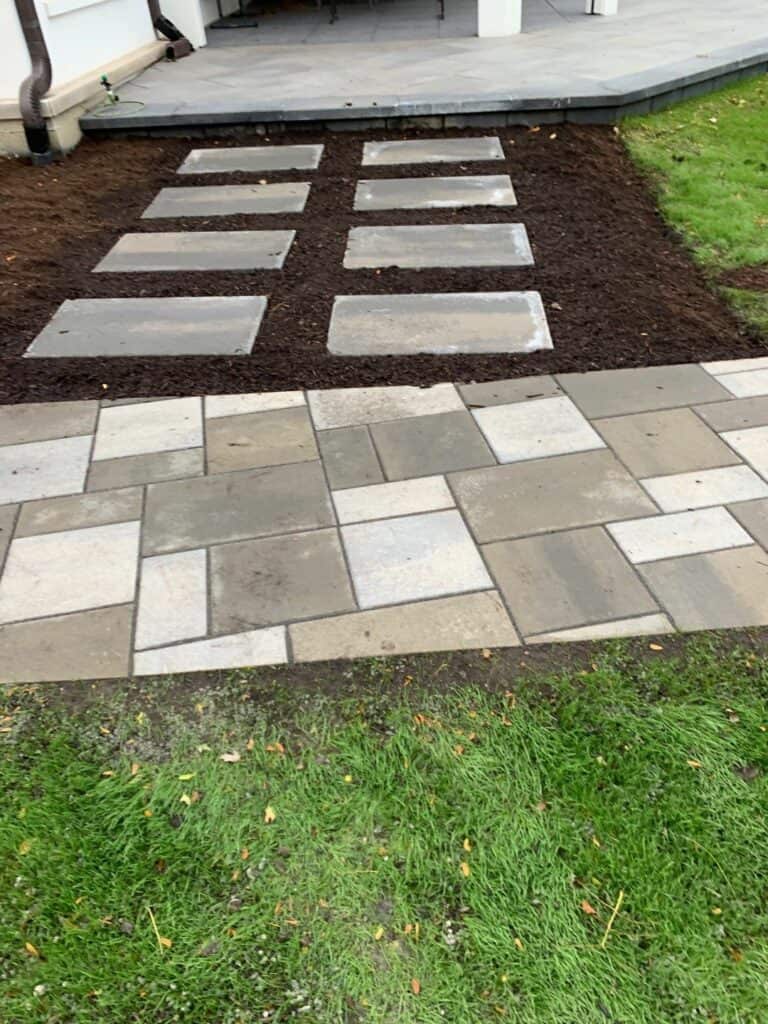
NRCS guidance says grading can direct surface water away from a house, and a minimum grade of 1 foot in 100 feet is generally adequate for that. Swales can channel water that ponds on lawns or driveways for long periods.
Before you commit, trace the new route to where the water will end up. If you can't see a surface path connecting the source, the low spot and an outlet, grading alone may not fix what you observed.
French drains: trace the outlet first
A French drain is only as good as where it sends the water. A 2003 Franklin County, Ohio soil and water conservation district fact sheet says soil characteristics determine the type of subsurface drain and calls the outlet extremely important. It names a storm drain, retention pond or stream as outlets, and advises against tying into an existing tile line, because an older system may be failing or over capacity, which can flood your property or a neighbor's.
So before talking about pipe size or depth, settle three things: your soil, the water the drain will collect, and where it will discharge.
Test the site before planning a rain garden
The Conservation Foundation describes a rain garden as a shallow depression planted with native wetland or wet-prairie wildflowers and grasses that gathers, filters and soaks rainwater into the ground. It may overflow in heavy rain, and the overflow should follow the lot's original drainage pattern.
University of Illinois Extension says:
- the garden's depth depends on a percolation test;
- incoming water should soak in within 24 hours, to avoid standing water that harms plants and creates mosquito habitat;
- the area needed to capture 1 inch of rain comes from the hard surface draining to it and the garden's depth;
- it should sit downhill from the surface it captures and uphill from the yard's lowest point, off septic fields, drain fields, wellheads and utilities, and more than ten feet from buildings with basements.
An existing soggy spot is not automatically a good site. Extension warns that sending more water into a poorly drained area can make the problem worse.
Does Mount Prospect help with drainage, and do you need a permit?
Mount Prospect says it works with residents on severe private-property drainage problems and may share improvement costs in some circumstances. It publishes no percentage or eligibility guarantee, so ask Public Works whether it applies to your property.
Start with Public Works for a substantial drainage problem
Mount Prospect directs residents to contact Public Works to discuss a substantial private-property drainage problem.
Bring a short description: where the water starts, how it crosses the property, where it collects, and whether neighboring or public drainage seems involved. Ask Public Works what property information it needs.
Buried downspouts on a flatwork permit
On a flatwork permit application (patios, driveways, walks), the Village asks for buried-downspout locations and their distance from the house on the plat of survey, and for the burial to be disclosed at submittal. If a proposal buries roof water, it should show the route and destination clearly enough to match that plat information.
Does drainage work need a Village permit?
Ask the Village before any drainage or grading work starts, and never assume no permit is needed. The Village's Licenses and Permits page gives this rule of thumb: "if it involves adding, moving, or exposing water, gas, electricity or walls, or it involves your property lines, it is going to need a permit!"
Other rules can apply depending on the work:
- Buried downspouts: on a flatwork permit application, shown on the plat of survey with their distance from the house and disclosed at submittal, as above.
- Regional stormwater rules: the Metropolitan Water Reclamation District says its Watershed Management Ordinance is not intended to regulate most single-family homes, and a permit is generally only required for single-family home development that involves a Flood Protection Area or a public sewer extension. Ask the Village or the District whether drainage work on an existing home is covered.
- Engineered drawings: the Illinois Code Enforcement Manual from IDFPR says local jurisdictions may require a licensed professional engineer to seal and sign site grading and site drainage drawings.
- Digging: JULIE says state law requires you to notify it at least 3 days (weekends and holidays not counted) and no more than 10 days before any digging project.
Wave Outdoors takes care of the permit for your project. The Village's handouts can change, so confirm the current requirements for your lot with the Village.
Questions to ask before you hire help
Ask every contractor the same questions:
- What did you observe that supports your diagnosis?
- Which part of the work addresses which water path?
- Where will redirected or collected water go?
- How did the soil affect the approach?
- Which lawn, beds and hard surfaces will be restored?
- Which permit submittals are included?
- What investigation or work is outside the quote?
For grading, ask which surface route will change. For a buried drain, ask how the soil shaped the choice and where it discharges. For a rain garden or dry well, ask how drainage, placement and overflow were checked.
What a French drain costs, and what moves the price
A national cost guide puts an exterior French drain at $10 to $65 per linear foot, or $1,000 to $6,500 for a 100-foot run. That is LawnStarter's national market range (updated October 5, 2026), not a Wave Outdoors price or a Mount Prospect quote.
The same guide says footing drains are more expensive, and hand digging raises labor when a trencher or mini-excavator can't reach the area.
In a finished, landscaped yard, compare proposals on four lines:
- Scope: drain length, what it collects and where it discharges.
- Depth: a shallow drain or a deeper footing drain, and why.
- Access: machine digging or hand digging.
- Restoration: how the lawn, beds and any hardscape crossed by the trench will be put back.
Ask for regrading as its own line too, with the area and the finished slope stated, so you can compare it across proposals.
Confirm the outlet, restoration and exclusions
The outlet deserves a specific answer, since the Franklin County, Ohio fact sheet calls it extremely important. NRCS guidance adds that drainage rules differ by community and advises checking local building codes for approved materials and other drainage regulations.
If a trench or regrade crosses a patio or walk, ask how the repair will keep water moving. University of Nebraska-Lincoln Extension says proper hardscape drainage helps prevent ponding and erosion, and permeable materials such as gravel or pavers with gaps can help manage runoff. The Concrete Masonry & Hardscapes Association recommends appropriate bedding and jointing sand to minimize water getting into pavers, and pavement slopes of typically at least 2% to drain surface water. For patio surfaces, see pavers vs concrete patio.
When regrading is the right next step
If your notes show surface water failing to drain away from the house, grading is the next thing to look at. NRCS guidance says yard grading should direct surface water away from the house. Our yard grading page covers how reshaping the grade changes that flow.
Wave Outdoors handles yard drainage in Mount Prospect and across Chicago's northwest suburbs. If your yard is holding water, write down what you've seen and Call (312) 772-2300 to talk it through.