
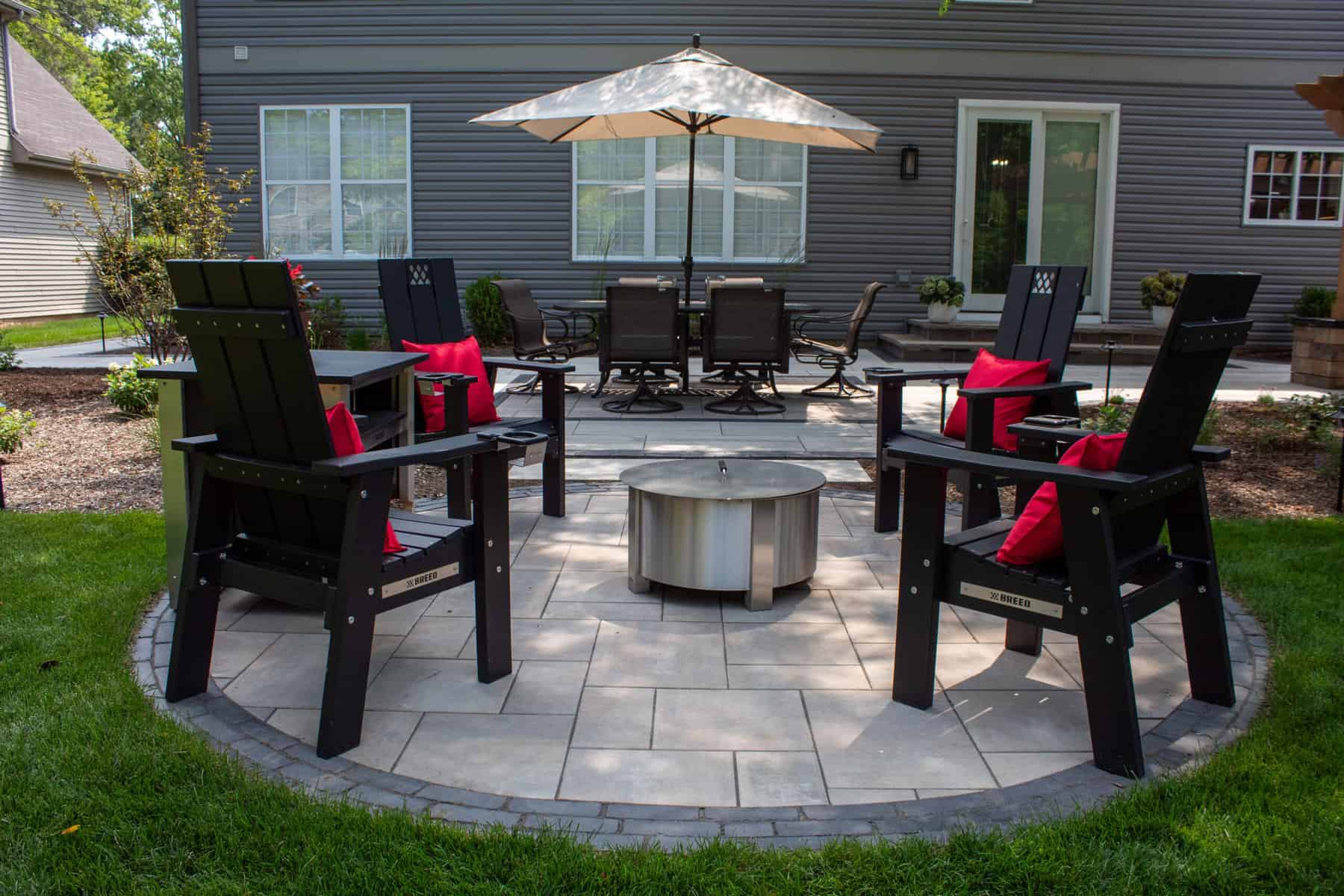
The pavers vs concrete patio choice comes down to repairs, winter care and budget. Pavers are individual units that can be lifted and reset over a minor low spot or for underground repairs. Concrete is one continuous slab, and patches on scaled concrete won't match the original color. In Chicago-area winters, how well either holds up depends on the base, drainage and winter care.
If budget drives your decision, compare written quotes with the same excavation, drainage, base and finish. A lower surface price doesn't mean a lower project price.
Pavers, poured concrete and stamped concrete compared
Pavers are individual units set on a layered base. Poured concrete forms a slab. Stamped concrete is poured concrete with a patterned, colored or textured surface. University of Nebraska-Lincoln Extension notes that concrete can be poured in place or used as preformed pavers, and that poured concrete can be stamped, colored or textured.
So stamping changes the look, not the construction. A stamped slab still depends on its subgrade, mix, thickness, joints, finishing and curing. A paver patio depends on its subgrade, aggregate base, bedding sand, joints and edge restraint working together.
| Pavers | Poured or stamped concrete | |
|---|---|---|
| Structure | Individual units on compacted subgrade, aggregate base, bedding sand, joints and edge restraints | A continuous slab on prepared subgrade, with joints that give normal movement designated locations |
| Freeze-thaw | CMHA says paver designs on a flexible aggregate base are often preferred in colder climates over rigid concrete-base paver designs, because they can offer greater protection against frost heave | CMHA says properly air-entrained and finished ready-mix concrete can resist freeze-thaw degradation |
| Typical winter damage | CMHA says paver heaves are typically caused by frost heave of the underlying soils | Scaling: water-saturated concrete exposed to repeated freezing and thawing can flake at the surface |
| Deicers | CMHA recommends a slope of typically at least 2% to drain surface water and help remove deicing materials | NRMCA advises avoiding deicers on newly placed concrete and never using ammonium sulfate, ammonium nitrate or magnesium-based salts |
| Repair | Units can be removed, the settled area adjusted, and the same pavers reinstalled | NRMCA says repair material for scaled concrete will not match the original concrete's color and characteristics |
| Upkeep | Spring and fall sweeping and joint-sand replacement when needed; CMHA says joint-sand stabilization is generally optional | A breathable silane- or siloxane-based sealer, applied when the concrete is reasonably dry |
Which costs less: a paver patio or a concrete patio?
It depends on the full scope, not the surface. Compare excavation, site preparation, base or slab specifications, drainage, finish, access and the repair plan. A lower surface allowance doesn't mean a lower project cost when the scopes differ.
For a whole-project reference, Wave Outdoors publishes a budget estimate of $10,000 to $100,000 for Hardscape Design & Patio Installation. That range covers the design-and-installation scope, not one material, so it can't tell you which surface will cost less on your site. A dimension-only price, such as one for a 20-by-20 patio, has the same limit. Ask for written quotes with the same scope instead.
What to ask every bidder
The National Association of REALTORS says project design, material quality, location, the home's age and condition, and homeowner preferences can influence both remodeling cost and cost recovery. Turn that into questions for each quote:
- What excavation and removal are included?
- How will soft, unstable or saturated soil be handled?
- What base, subbase or slab specification is included?
- How will the patio drain?
- Which finish, pattern, color, border or joint treatment is included?
- How will tight site access affect the work?
- What is excluded or priced separately?
- What would a spot repair require later?
Stamped concrete versus pavers
Compare them at the same size, site and preparation. A stamped-concrete quote should name the slab construction and the surface treatment; a paver quote should name the base layers, the paver, the edge restraint and the joint treatment. If only one quote includes drainage correction or difficult access, the totals aren't comparable yet.
How do pavers and concrete handle Chicago winters?
Neither surface wins by default. CMHA, the paver-industry association, says properly air-entrained and finished ready-mix concrete can resist freeze-thaw degradation. For pavers, CMHA's cold-climate guidance is about the base: designs on a flexible aggregate base are often preferred in colder climates over rigid concrete-base designs, because they can offer greater protection against frost heave.
Concrete holds up best when the slab is air-entrained, correctly jointed and finished, and kept away from harsh deicers. Pavers depend on the soil, base, drainage, bedding, restraint and the condition of the joints, and units over a minor low spot can be lifted and reset. Neither system is failure-proof.
Frost reaches well below the surface in northern Illinois. An Illinois State Water Survey post on frost depth describes a 1980 to 1996 study of grave-digger observations in which the deepest observed frost ranged from 5 inches in far southern Illinois to 30 inches in far northern Illinois. That's why the base and drainage under either surface matter as much as the finish you see.
Scaling and moisture exposure
Water-saturated concrete exposed to repeated freezing and thawing can scale, and deicing chemicals can add to that exposure. NRMCA defines scaling as localized flaking or peeling of a hardened concrete surface caused by freeze-thaw. Light scaling doesn't expose the coarse aggregate; severe scaling leaves it clearly exposed.
NRMCA lists non-air-entrained concrete, too little air near the surface and improper finishing among the causes of most scaling. Air-entrained concrete contains tiny bubbles that give expanding water and ice room, which reduces stress inside the concrete. Minor scaling is cosmetic and may not need repair; light to moderate scaling can be repaired, but excessive and progressing scaling may make slab repair impractical.
Deicing and snow removal
Deicer chemistry, application amount and drainage all affect winter care for concrete, and snow-removal technique matters for pavers.
For concrete, NRMCA advises avoiding deicing chemicals on newly placed concrete when possible and using clean sand for traction. It says ammonium sulfate, ammonium nitrate and magnesium-based salts should never be used as concrete deicers.
CMHA reports research prepared for the Utah Department of Transportation in 2013 that found only minor, if any, adverse effects on concrete exposed to sodium chloride, while specimens exposed to calcium chloride, magnesium chloride or calcium magnesium acetate deteriorated significantly. CMHA notes that the review did not specifically address unit pavers. It calls rock salt (sodium chloride) the least damaging deicer for concrete materials, advises against over-applying it, and doesn't recommend magnesium chloride or calcium magnesium acetate.
For pavers, CMHA recommends its specified jointing and bedding sands to limit water getting in, and a pavement slope of typically at least 2% to drain surface water and help remove deicers. It recommends shoveling or plowing diagonally across the joints so the blade doesn't catch paver edges, and repairing heaved or lifted units with lippage over 1/8 inch before winter. Winter traction sand can help keep joints filled, but sweep the excess off in spring: CMHA says sand left on the surface year after year can increase abrasion and wear.
Frost movement beneath pavers
CMHA says paver heaves are typically caused by frost heave of the underlying soils, and it recommends frost-resistant subbase materials when repairing frost-caused heave.
So what sits under the pavers is part of the winter decision. In CMHA's terms, a flexible design places aggregate, treated aggregate or asphalt beneath the pavers and bedding layer; a rigid design sets them on a concrete base.
Installation details to compare for both patio systems
Both systems need prepared ground, positive drainage and the right construction details, so a good quote describes what's underneath as clearly as the finish. Ask what will be removed, what will support the surface, how water will move and what controls movement at the surface and edges.
Pavers over an existing slab? If the plan reuses an old concrete patio, for example by setting thin pavers over it, ask whether the slab will be removed or used as a base, what condition it must be in, and how water will drain off it.
Paver base, bedding and restraint
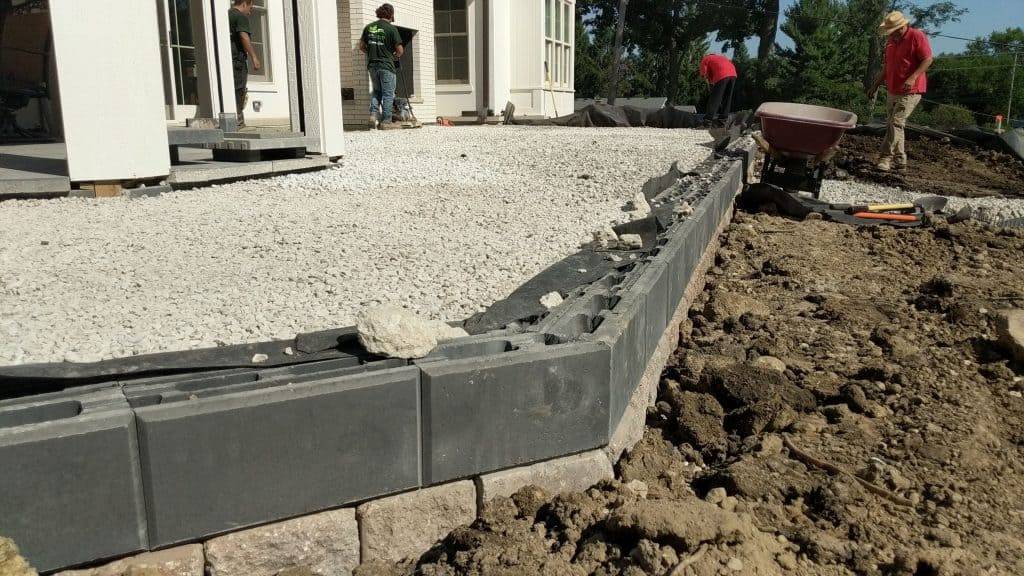
CMHA's construction guidance covers each layer:
- Subgrade: compacting the soil is critical because it minimizes settlement; CMHA calls for at least 98% of standard Proctor density under the conditions in its guide.
- Base: thickness depends on traffic, soil, subgrade drainage and climate. The guide's minimum for patios and other pedestrian areas over well-drained soils is 4 inches compacted, with thicker bases over continually wet or weak soils in colder climates.
- Geotextile: a possible separation layer where soil stays seasonally saturated, where freeze-thaw occurs, or over clay and moist silty soils. It keeps soil from migrating into the base.
- Compaction: spread and compact the base in lifts with reversible plate compactors. Never install frozen base material or place it over frozen soil.
- Bedding sand: ASTM C33 or CSA A23.1 concrete sand, about 1 inch thick and uncompacted. Not masonry sand, limestone screenings or stone dust, and never used to correct an uneven base, because the unevenness can show through later.
- Edge restraint: provides lateral resistance and keeps the units interlocked. Typical materials are aluminum, steel, plastic and concrete.
- Final compaction: at least two passes with a vibrating plate to seat the pavers and force sand into the joints.
Poured-concrete specifications and joints
For residential exterior flatwork, the Illinois Ready Mixed Concrete Association (IRMCA) recommends 4,500-psi specified compressive strength at 28 days, a maximum water-to-cement ratio of 0.45, and total air content of 6.0% plus or minus 1.5%.
NRMCA gives separate guidance by exposure. It recommends 4,000-psi air-entrained concrete when an exterior slab will stay continuously moist, face freezing and receive deicers, and 3,500 psi when it won't. For freeze-thaw exposure with 3/4-inch or 1-inch coarse aggregate, it recommends 6% total air. Because these sources cover different scopes, a quote should state the actual mix and exposure assumptions.
- Subgrade: IRMCA says it should contain no organic or uncompacted material, with unstable material removed to at least 6 inches. NRMCA says to remove all topsoil and soft spots and slope the slab and subgrade for drainage. Both say not to place concrete on a frozen subgrade or subbase.
- Thickness: IRMCA recommends at least 4 inches for residential flatwork and 5 inches where delivery vehicles or other heavy loads are expected.
- Finishing and curing: IRMCA warns against finishing while bleed water is visible and doesn't recommend a California steel-trowel finish in freeze-thaw areas. NRMCA names insufficient curing as a cause of scaling. Ask each bidder to state the finishing method and the curing plan separately.
- Control joints: NRMCA recommends maximum spacing of 24 to 36 times the slab thickness, limited to 15 feet. IRMCA recommends 2 to 2.5 times the slab thickness in inches, converted to feet, which gives panels from 8 by 8 to 10 by 10 feet for a 4-inch slab, kept as square as possible.
- Isolation joints: IRMCA describes full-depth joints with compressible filler at walls, foundations and steps. NRMCA says they separate slabs from restraint points to help minimize cracking.
- Use after placement: under normal conditions, IRMCA says foot traffic can start after 48 hours, and vehicles should stay off for 7 days.
Slope and drainage
Both systems need positive surface drainage, settled before installation. For concrete flatwork, IRMCA recommends a minimum slope of 1/4 inch per foot, and NRMCA says the slab and subgrade should be sloped for drainage. For pavers, the 2% figure above is the finished surface slope; separately, CMHA's construction guide specifies a minimum slope of 1.5% while preparing the paver excavation. CMHA also recommends perimeter perforated drains in clay or other slow-draining soils under vehicle traffic. Your site's drainage design should settle the grade. If water already pools in your yard, start with backyard flooding solutions.
Where permeable pavers fit
Permeable pavers are a stormwater decision as much as a surface choice. CMHA says permeable interlocking concrete pavement (PICP) is recognized by federal and state stormwater and transportation agencies as a Best Management Practice and Low Impact Development tool to reduce runoff and water pollution.
If runoff is part of the reason for your project, ask each bidder:
- Is this proposal a designed permeable system?
- How will the base hold and release water?
- Where does the water go when the base is full?
Which lasts longer, and how is each one repaired?
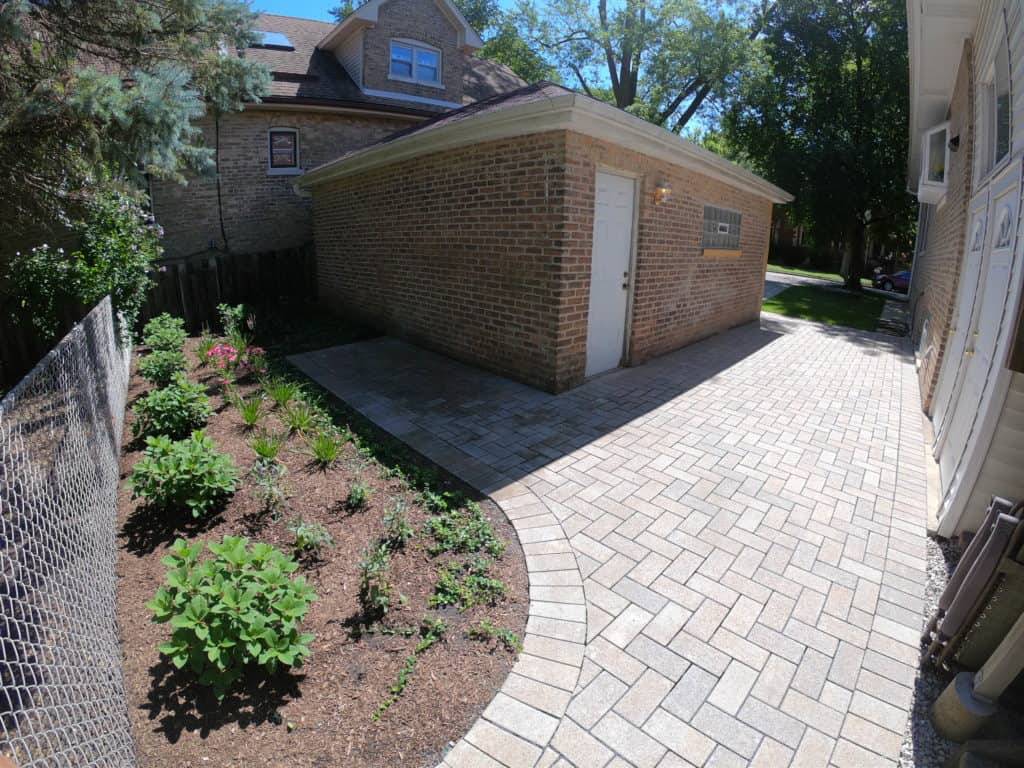
Neither surface has a sourced lifespan figure, so the useful difference is repair. CMHA describes removing and reinstalling pavers to fix low-severity depressions or for underground repairs. NRMCA says repair material for scaled concrete will not match the original concrete's color and characteristics.
Resetting pavers
Low-severity depressions can be fixed by removing the units, adjusting the settled area and reinstalling the same pavers. CMHA compares pavers to a zipper: the pavement can be opened for underground work and closed again without jackhammers on the surface.
Resetting doesn't fix the cause. CMHA says depressions come from settlement of the subgrade or granular base, often because of inadequate compaction.
Cracks, scaling and slab patches
NRMCA says all concrete has a tendency to crack and concrete that never cracks can't be produced, although good practice can reduce and control cracking. It attributes most cracks to design or construction problems such as omitted or improper joints, poor subgrade preparation, improper finishing and inadequate curing. Wire mesh can't prevent cracking, though properly positioned reinforcement can reduce crack width.
Most random early cracks rarely affect concrete's structural integrity or service life, NRMCA says. It names D-cracking from freeze-thaw damage in some porous aggregates, and cracking from alkali-aggregate reactions, as exceptions.
How much upkeep does each surface need?
Pavers need sweeping and their joints kept full. Concrete needs its surface protected through winter and a sealer applied on schedule. Neither sealers nor joint stabilizers fix an unstable base or replace proper concrete curing.
Paver joints and seasonal care
CMHA recommends preventive care in spring and fall: sweep in spring to remove leftover deicers and winter sand, and in fall to clear dirt and leaves. It calls joint sand essential to interlock and pavement stiffness, and says pressure washing and pumping from saturated bedding sand under traffic can wash it out. Where wind, runoff or heavy cleaning removes joint sand, CMHA says it can be replenished with dry masonry sand, and it doesn't recommend polymeric sand just for topping up existing joints.
Sealers, stabilizers and efflorescence
CMHA says joint-sand stabilization is generally optional and not required for many interlocking pavements, because fines tend to stabilize the joints over time.
Paver sealers do a different job. CMHA says they reduce intrusion by water, stains, oils and dirt and can intensify paver colors, but they don't increase structural strength or load capacity. Silane and siloxane products penetrate concrete and repel incoming moisture while letting water vapor escape; they can deter efflorescence and give a flat, non-gloss finish. Acrylic sealers enhance color, add gloss and generally protect against surface wear longer than silanes or siloxanes, but typically need recoating after a few years.
Efflorescence is the whitish, powder-like haze that forms when calcium hydroxide from the cement reaches the surface and reacts with carbon dioxide to form calcium carbonate. CMHA says it doesn't affect the structural performance or durability of concrete pavers. It can appear right away or months later, may peak in as little as 60 days, and can last for months while some of it wears away.
Concrete sealing and use after placement
IRMCA says sealers minimize water and deicing-salt penetration, and that an integral sealer doesn't remove the need for proper curing. It says a silane- or siloxane-based penetrating sealer may be applied 30 days after placement, with reapplication based on traffic and the manufacturer's instructions.
NRMCA recommends a breathable silane- or siloxane-based sealer or water repellent made for concrete slabs, applied when the concrete is reasonably dry. It names late summer, after several dry days, as an ideal time.
How to choose for your site and upkeep
Pick pavers if easy spot repairs and access underneath matter most to you. Pick poured or stamped concrete if you want one continuous surface and will follow its deicer and sealing rules. Either way, don't let a decorative sample stand in for the specification underneath it.
Your final comparison checklist
Record the same items for every option, and ask your local authority and designer to confirm the code and frost-depth requirements for your site:
- Patio size, use and expected loads
- Soil, saturation and drainage concerns
- Excavation, removal and access assumptions
- Base and joints (pavers) or mix, thickness, finish, curing and joints (concrete)
- Surface slope and any separate drainage work
- Winter deicing plans and sealer or joint-treatment choices
- The plan for settlement, cracking, scaling or underground access
- Work that is excluded or priced separately
Wave Outdoors designs and builds patios for homeowners across Chicago's northwest suburbs from its base in Mount Prospect. See our paver patio installation page for how we approach patio projects, and when you're ready to plan yours, Get Started.